










You brush your teeth regularly, take your time with your routine, and yet sometimes you still have that feeling that there could be more to it. Exactly this feeling is often a very clear indication from your body. Because even if your teeth feel smooth and look clean, there are areas left behind that you can hardly reach with a toothbrush alone. These are the interdental spaces, which are often overlooked in everyday life, although they play a central role in your oral hygiene.
In this article, we explain how to use dental floss correctly, why it is a crucial part of your daily dental care, and how to integrate it into your daily life so that it doesn't feel like an additional chore, but like a natural part of your routine. At the same time, we'll look at common mistakes and why it's worth consciously addressing the topic.
Because dental care is not a rigid system of individual steps. It is an interplay of understanding, technique, and habit. And this is exactly where the difference begins.
Why dental floss is more than just an extra
If you take a look at your daily dental care, you'll find that it usually focuses on what you can see and feel. The visible tooth surfaces, the feeling of smooth teeth after brushing, maybe even fresh breath. But a large part of your tooth surfaces lies exactly where your gaze doesn't automatically go. In the narrow spaces between your teeth.
These areas are particularly susceptible to plaque accumulation. Not because you're doing something wrong, but because the anatomy of your teeth simply makes it difficult to reach them completely with a normal toothbrush. Even with careful brushing, these areas often remain inadequately cleaned. It is at this point that it becomes understandable why dental floss is not an optional addition, but a sensible part of well-thought-out oral care.
At the same time, it is important to correctly classify the role of dental floss. It is not a substitute for brushing your teeth. It cannot take over the entire cleaning, but specifically complements what the toothbrush alone cannot achieve. The basis of your oral hygiene always remains a thorough cleaning of your tooth surfaces.
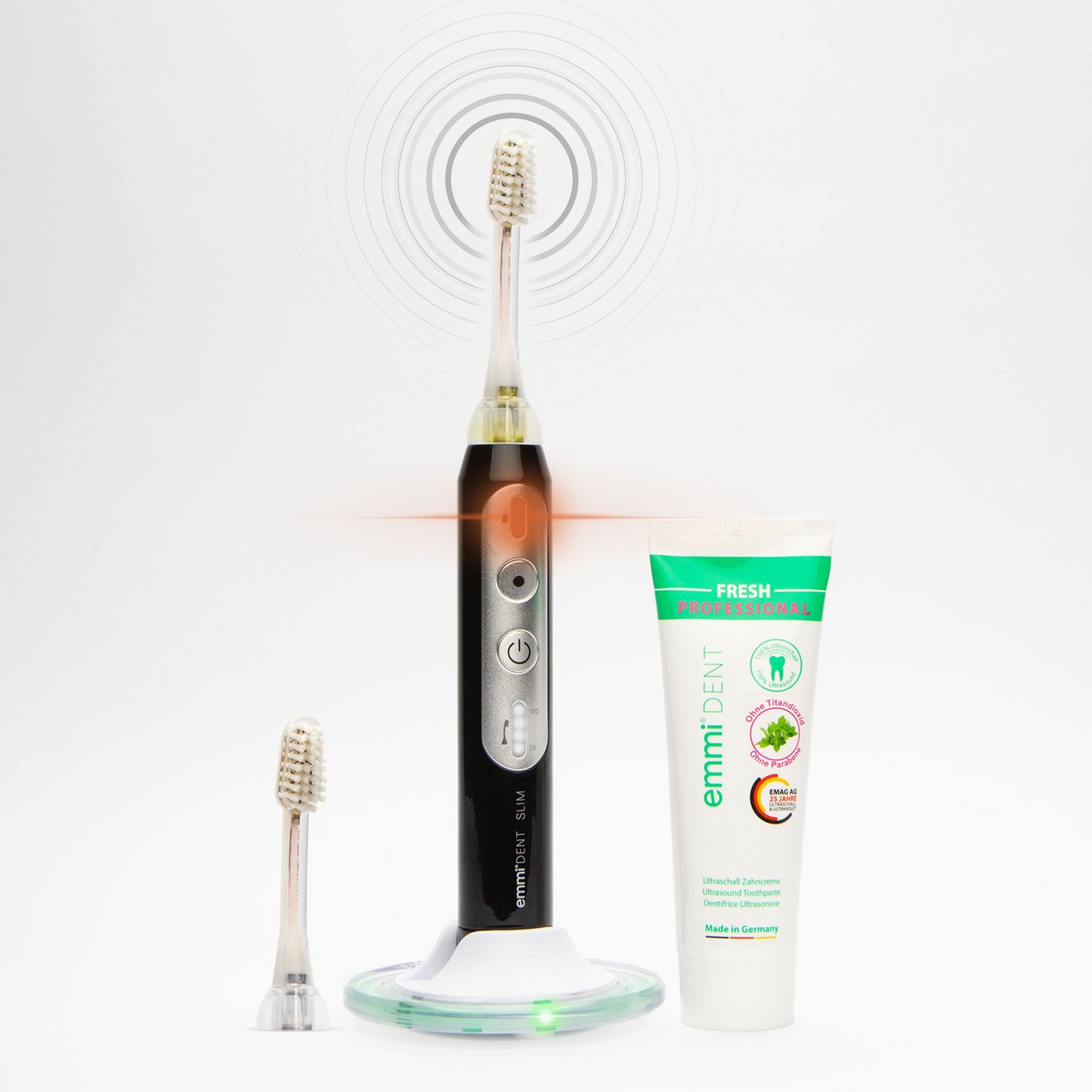
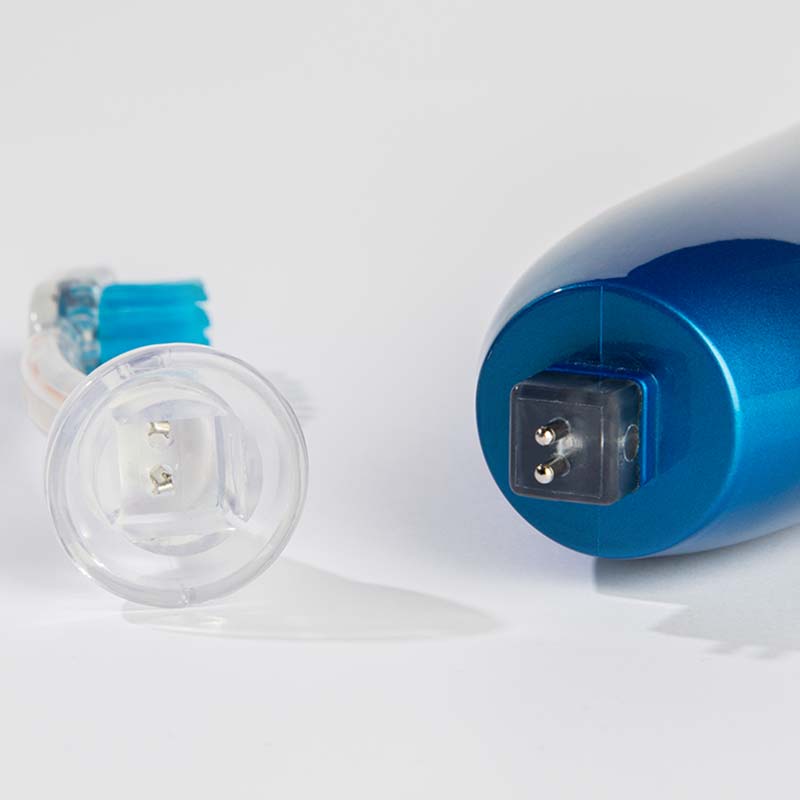
The choice of your toothbrush also plays a decisive role here. If you work with our emmi-dent Slim ultrasonic toothbrush, for example, you use a technology that can reduce bacteria even in hard-to-reach places without having to apply mechanical pressure. This means that you achieve very gentle and at the same time deep-reaching care during the basic cleaning.
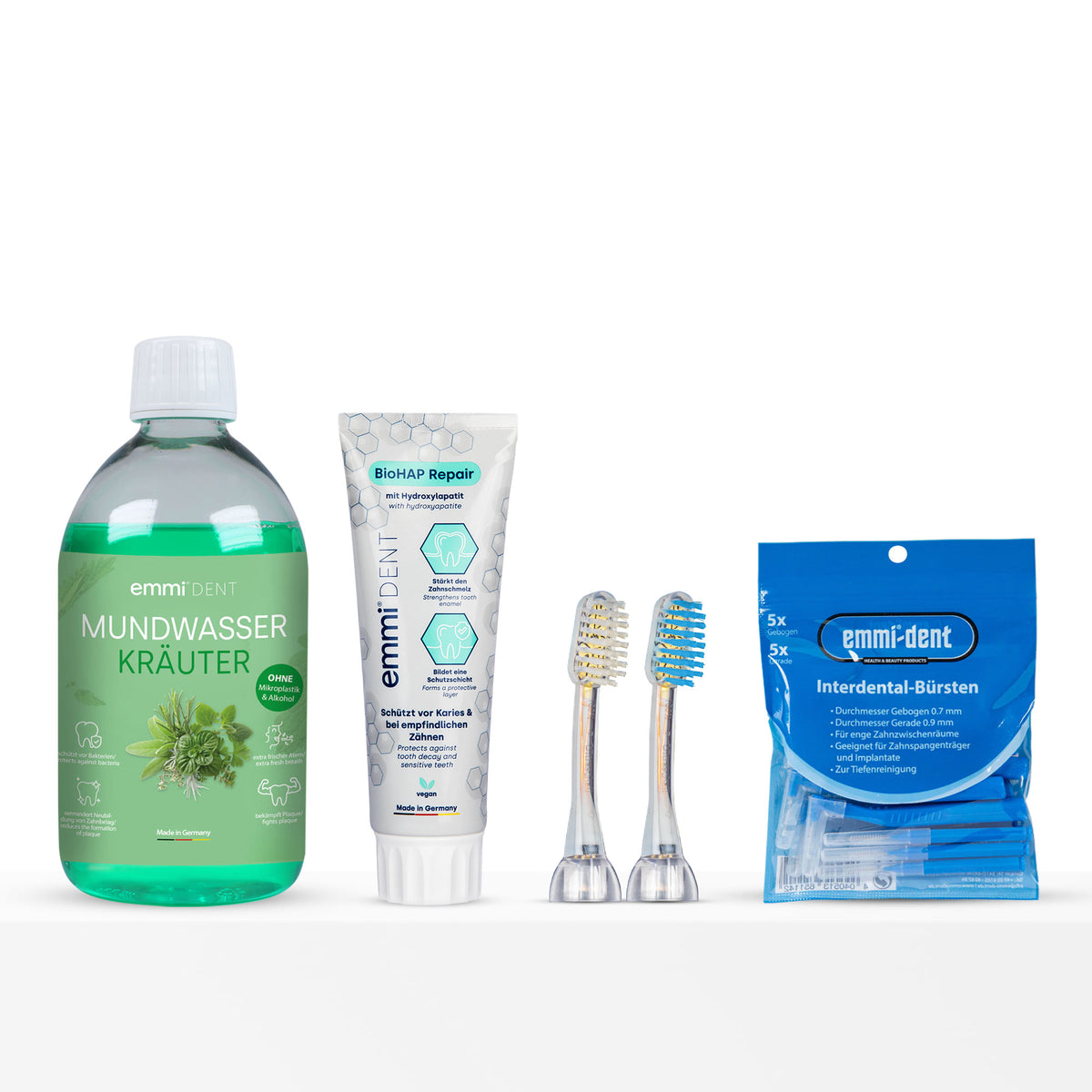
Dental floss complements this effect exactly where you can specifically intervene. It helps you to mechanically clean the interdental spaces and remove plaque that accumulates in everyday life. This interaction becomes particularly useful when you consciously view your dental care as an overall system. Our combinations such as the emmi-dent Slim white teeth set or the emmi-dent Platinum Nature Set also support you in building a routine that does not consist of individual isolated steps, but is intertwined.
This interaction ensures that your oral sensation changes in the long run. It not only becomes cleaner, but also more stable and balanced.
How to use dental floss correctly
If you want to use dental floss correctly, it's worth not doing it casually, but consciously paying attention to it. The technique is less complicated than it seems at first glance. It is crucial that you understand what you actually want to achieve. It's not about simply pulling the dental floss between your teeth, but about specifically cleaning the surfaces where plaque accumulates.
The first step is proper preparation. Take a sufficiently long piece of dental floss, about 40 to 50 centimeters. This length gives you the opportunity to use a fresh section for each interdental space and to guide the floss in a controlled manner. Loosely wrap the ends around your fingers so that you can build tension without it becoming uncomfortable. This control is crucial because it allows you to work calmly and precisely.
When inserting the dental floss between your teeth, patience is required. Instead of pushing it down with pressure, you should work with a light sawing motion. This allows the floss to glide gently into the interdental space and you avoid unnecessary irritation of the gums. As soon as you reach the area where the tooth and gums meet, the actual cleaning begins.
Now place the dental floss in a slight C-shape around the tooth. This shape ensures that you actually reach the surface and don't just superficially go through the interdental space. Move the dental floss slowly and controlled up and down along the tooth. This is exactly where you remove the plaque that has accumulated throughout the day.
One point that is often underestimated is the fact that each interdental space consists of two tooth surfaces. Many only clean one side and then move on. However, if you really want to work thoroughly, you should consciously clean both sides one after the other. Only then do you move on to the next tooth.
Over time, this process becomes more and more natural. What initially required concentration becomes a calm, almost automatic movement.
Using dental floss correctly for molars
The molars are the most difficult area for many to apply. They are far back in the mouth, difficult to see, and often harder to reach. That's why they are often neglected in everyday life, even though plaque particularly often accumulates there.
If you want to use dental floss correctly for molars, it helps to consciously take more time and slightly adjust your posture. Open your mouth a little wider and change the position of your fingers so that you have more control over the movement. Work particularly slowly and carefully here, instead of trying to finish quickly.
Especially in this area, you can see how important patience is. With a little practice, you will notice that the back areas also become increasingly accessible. It is crucial that you do not exclude them from your routine.
Before or after brushing – what makes sense
The question of whether you should use dental floss before or after brushing your teeth comes up again and again. And it's understandable because many people want to optimize their routine as much as possible.
If you use dental floss before brushing, you remove plaque from the interdental spaces, which can then be removed more easily during brushing. This order can feel particularly logical because it supports the cleaning effect.
If you use dental floss after brushing, you specifically address the areas that were left behind during brushing. So you consciously rework and refine your cleaning.
Both approaches are justified. There is no universally right or wrong here.
More important than the order is the question of whether you use dental floss regularly at all. Because only through continuity does an effect arise that you also feel in the long term.
Typical mistakes when using dental floss
Even if dental floss seems simple, there are some typical mistakes that can significantly limit its effectiveness. One of the most common is too much pressure. Many try to force the dental floss between their teeth, which can quickly lead to gum irritation. However, the application is actually about control and finesse, not force.
Another mistake is pulling the dental floss through too quickly. In this case, dental floss is formally used, but the actual cleaning does not take place. The tooth surfaces are not specifically worked on, so plaque remains.
Irregularity also plays a major role. If you only use dental floss sporadically, your gums cannot get used to it. This often leads to the application being perceived as uncomfortable, although it becomes much more pleasant with regular use.
In addition, the same section of dental floss is often used multiple times. This tends to distribute loosened plaque rather than remove it. If you work consciously clean here, the result improves significantly.
Dental care on the go – dental floss as a practical addition
In everyday life, there are many situations in which you cannot immediately implement your usual dental care. After eating on the go, in the office, or after a coffee, there is often no way to directly grab a toothbrush.
In such moments, dental floss can be a useful addition. It helps you to remove food debris from the interdental spaces and thus ensures a more pleasant feeling in the mouth. Especially if something has gotten stuck, this small step can immediately bring relief.
However, it is important to correctly classify the function. Dental floss does not replace complete dental care. It is an intermediate solution that helps you bridge the moment until you can resume your usual routine.
How often should you use dental floss
The ideal recommendation is clear. Once a day is a sensible guideline if you want to keep your interdental spaces clean permanently. But less important than perfect implementation is regularity.
If you haven't used dental floss before, it makes sense to approach it slowly. Start with a few applications per week and gradually increase. Your gums will get used to it and the application will become much more pleasant over time.
With each repetition, you develop a better feel for the technique. At the same time, your oral sensation changes because you reach areas that were previously untouched.
Dental floss as part of holistic oral care
Dental floss only unfolds its full effect when you view it as part of a larger whole. It is an important building block, but not the sole solution. The basis always remains regular tooth brushing.
If you perform your daily cleaning with our emmi-dent Slim ultrasonic toothbrush, for example, you benefit from particularly gentle and at the same time deep-reaching care. The ultrasound technology helps you to reduce bacteria even in hard-to-reach places.
Dental floss specifically complements this process by taking over the mechanical cleaning of the interdental spaces. Together, a routine is created that is significantly more comprehensive than individual measures alone.